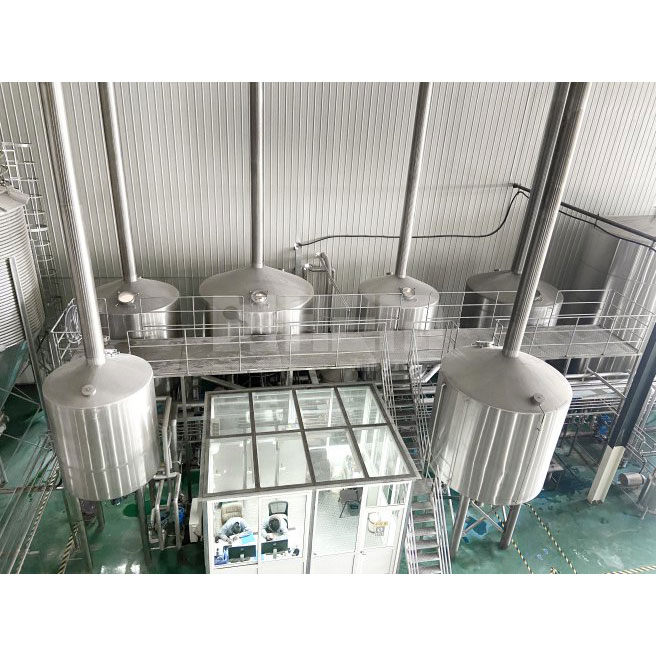
Professional beer brewing equipment should be selected from production volume backward, not from tank size forward. A 10-barrel brewhouse running two turns produces 20 barrels of wort per brew day, but fermenters occupied for 14–21 days usually set the real production limit. Heating method, cellar capacity, glycol output, water supply, packaging speed, floor space, and cleaning time all need to match the same production schedule. In 2024, 9,796 craft breweries operated in the U.S., while craft beer production fell 3.9%, so adding unnecessary capacity is harder to justify than matching equipment closely to realistic sales and labor requirements.
Start with finished-beer volume rather than the advertised brewhouse capacity. If a brewery expects to sell 2,000 barrels a year and operates 48 brewing weeks, average finished output is about 42 barrels per week. A 10-barrel system brewing five batches weekly provides 50 barrels of gross wort capacity before fermentation and packaging losses. That leaves some scheduling room without installing a brewhouse several times larger than current demand.
Production planning also needs to reflect the market around the equipment. U.S. craft brewers produced 23.1 million barrels in 2024, down 3.9% from 2023, while craft volume represented 13.3% of the U.S. beer market. Retail dollar value still reached about $28.8 billion, showing why a brewery may need good production control rather than maximum possible output.
A brewhouse can finish a batch in several hours; a fermenter may hold that batch for two or three weeks.
Fermentation capacity should therefore be calculated immediately after brewhouse size. A brewery producing 10 barrels per batch and brewing four times each week places 40 barrels into fermentation. With an average 14-day residence time, about 80 barrels of active fermentation space is already occupied before allowing for dry hopping, conditioning, cleaning, delayed yeast activity, or seasonal beers.
A practical installation might use several 20-barrel fermenters with a 10-barrel brewhouse, allowing two brews to fill one vessel. The arrangement reduces tank count, but it also requires two batches to have very similar wort composition and timing. Breweries producing many rotating recipes may prefer smaller vessels because a 20-barrel tank occupied by a low-volume beer removes twice the cellar space of a 10-barrel tank.
Equipment choice also depends on how many brews must be completed during one shift. A compact two-vessel brewhouse can work well when one or two daily turns are enough. Separating mash, lauter, kettle, and whirlpool functions can allow more process overlap when three or more turns are planned.
| Production item | Example planning figure | What to check |
|---|---|---|
| Brewhouse | 10 bbl | Net wort per batch |
| Brew frequency | 4 batches/week | Labor hours and cleaning |
| Fermentation | 14–21 days | Tank availability |
| Fermenter size | 10 or 20 bbl | Single or double batching |
| Annual schedule | 48 weeks | Maintenance and holidays |
Heating should be chosen after the brew-day schedule is known. Electric elements reduce the need for a separate steam boiler and can suit smaller breweries, but available electrical service must support the brewhouse, chiller, pumps, cold room, air compressor, and packaging equipment at the same time.
Steam becomes more practical as batch size and daily brewing frequency rise. Jacketed steam heating can provide broad heat-transfer area around the vessel, while a boiler introduces additional piping, condensate return, water treatment, inspection, ventilation, and maintenance requirements. Comparing an electric kettle price against a steam-jacketed kettle without including the utility installation gives an incomplete cost comparison.
Tank construction deserves the same attention as heating. Professional fermenters are commonly built with stainless product-contact surfaces, insulated walls, cooling jackets, sanitary valves, pressure controls, spray devices, temperature probes, and conical bottoms. A quotation should state material grade, vessel thickness, working pressure, test pressure, internal finish, jacket arrangement, insulation thickness, welding standard, and included fittings rather than simply saying “stainless steel fermenter.”
That level of specification matters because cleaning takes place after every production cycle. An internal weld, valve pocket, poorly draining pipe section, or difficult-to-reach fitting can retain soil even when the rest of the tank looks clean. Equipment geometry should allow cleaning liquid to contact product surfaces at repeatable flow, temperature, chemical concentration, and contact time.
Cooling capacity then needs to match the cellar rather than one fermenter. Fermentation produces heat, while cold conditioning and crash cooling require the refrigeration system to remove substantially more heat over a shorter period. A brewery with eight fermenters should calculate what happens when several tanks are fermenting while another two are being cooled from fermentation temperature toward near-freezing conditions.
A glycol quote should therefore include:
-
Total refrigeration capacity at the specified glycol temperature.
-
Pump flow and pressure at the full distribution distance.
-
Supply and return pipe diameter.
-
Number and area of tank cooling jackets.
-
Ambient design temperature.
-
Allowance for future cellar tanks.
Utility efficiency can produce large differences between breweries. Brewers Association benchmarking data for 10,000–100,000-barrel breweries reported a 2016 sample of 26 breweries with median water use of 5.3 barrels of water per barrel of beer; the better-performing 25% used roughly 3.3–4.0 barrels. The same report used 28 breweries for electricity data, with a median of 22.4 kWh per barrel.
Water capacity should therefore be checked before a craft brewery system is ordered. Brewing water is only part of consumption. Tank rinsing, CIP cycles, keg washing, packaging, floor cleaning, heat-exchanger operation, and hot-water preparation may occur during the same shift. Brewers Association guidance has reported an industry water-use ratio near seven barrels of water per barrel of beer, while efficient operations can operate below three-to-one.
Hot liquor storage must also match the brewing sequence. A 10-barrel brewhouse does not automatically need a 10-barrel hot liquor tank; strike water, sparge water, equipment heating, cleaning, and recovery from wort cooling can require a different volume. Heat recovered through the wort heat exchanger can be returned as warm or hot process water, reducing the amount that must be heated again for the next batch.
Packaging capacity comes next because fermenters cannot be emptied faster than finished beer can leave the cellar. A brewery packaging 40 barrels in one day needs enough canning, bottling, or kegging capacity to process that beer within available labor hours while maintaining carbonation and oxygen specifications.
Brewers Association guidance for mobile canning recommends keeping dissolved oxygen in packaged beer below 50 parts per billion and checking total package oxygen at the start of every packaging run. A fast filler that repeatedly introduces excess oxygen may reduce packaged-beer quality despite increasing cans per minute.
Throughput should be measured as acceptable packaged beer per hour, not simply containers filled per minute.
Automation should be judged in the same practical way. Automated valves, recipe controls, temperature loops, level sensors, flow meters, variable-frequency pump controls, and programmable cleaning sequences can reduce repeated manual work. They also increase the number of sensors, actuators, electrical components, and software functions that require maintenance.
For a brewery running one batch a day, manual valves and simple temperature control may provide enough repeatability. At three or four daily turns, automated process steps can reduce operator involvement during transfers and temperature changes. Replacement PLC modules, sensors, pumps, valve actuators, and VFDs should be locally obtainable or stocked as spares.
Building dimensions need to be checked before tank drawings are approved. Vessel diameter, overall height, leg height, manway position, valve clearance, rigging angle, doorway dimensions, roof structure, floor loading, trench drains, and service access can change whether the selected equipment can actually be installed.
A 4-meter fermenter inside a building with a 4.2-meter ceiling may still be impossible to stand upright because installation requires rotational clearance. The same problem occurs when a tank fits through the production room but cannot pass a loading door. A scaled layout should show equipment and installation paths, not only final tank positions.
Safety provisions belong in the same layout. Fermentation and beer transfer use carbon dioxide, which can accumulate in low or poorly ventilated areas because CO₂ is denser than air. Fixed monitoring, ventilation, cylinder or bulk-tank placement, safe pressure-relief discharge, and staff procedures should be specified before commissioning rather than added after production begins.
Finally, compare quotations line by line instead of comparing one total number. The U.S. had 9,922 breweries in 2024, and 529 breweries closed during that year, compared with 430 openings. Equipment purchases therefore need to fit realistic operating volumes and available capital rather than assuming continuous market growth.
A useful supplier comparison should record brewhouse capacity, vessel count, stainless specification, heating area, cooling area, pump rating, automation components, electrical load, refrigeration capacity, documentation, freight, installation, commissioning, training, warranty terms, spare parts, and service response. A lower quotation can simply contain fewer valves, smaller heat-transfer surfaces, less automation, or no commissioning.
Supplier references should come from breweries using similar equipment sizes, not only large showcase installations. Ask how long the system has operated, how many weekly batches it runs, whether the quoted heating and cooling times are achieved, what components have failed since installation, and how replacement parts were supplied.
The same review should cover future expansion without buying unused tanks immediately. Leaving floor positions for two additional fermenters, sizing glycol headers with spare connections, reserving electrical-panel capacity, and planning pipe routes during the first installation usually costs less than rebuilding utilities after production has already filled the room.