How Luck and Hashrate Shape the Wait for 0.01 BTC
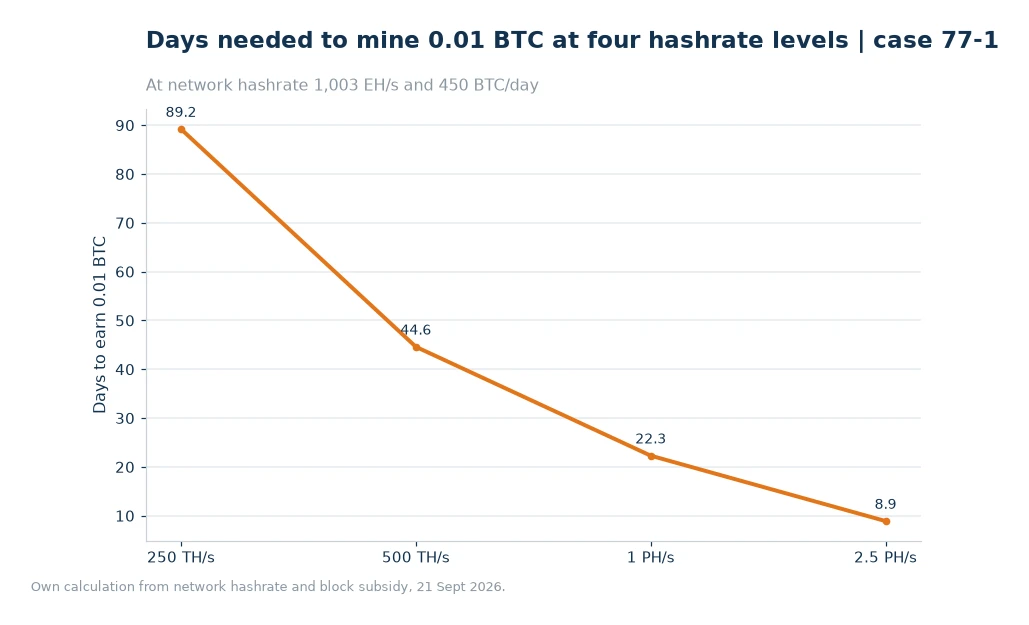
A mining target is a race against a random process with a known average. At 250 TH/s the average is 0.00011215 BTC a day, so 0.01 BTC takes 89.2 days, worth $846.92 at $84,692. Around that average sits a spread, and the spread is what Pool Luck describes.

Key takeaways
- 250 TH/s credits 0.00011215 BTC a day, putting 0.01 BTC 89.2 days away at current conditions.
- At 2.5 PH/s the same target takes 8.9 days, because the daily rate scales with hashrate.
- Pool Luck compares blocks found with blocks expected; over short windows it swings widely.
- PPS+ removes luck from your credit, while PPLNS passes it through with the block payments.
What luck is measuring
Block discovery is a random process with a fixed average rate. Given its hashrate and the network difficulty, a pool can expect a certain number of blocks in a day. Pool Luck divides the blocks it actually found by that expected number. A pool that found nine when ten were expected reads 90%; one that found eleven reads 110%. Neither result implies anything about the next day, because each block is an independent draw.
This is the same arithmetic as flipping a coin and counting heads. Twenty flips can easily produce fourteen heads, and that does not make the coin biased. A pool with a small share of the network is flipping a small number of coins, so its luck figure is noisy by construction. A pool with a large share flips more often and its figure settles closer to 100%.
The practical consequence is that luck is a property of the pool's sample size as much as of its performance. Comparing two pools' luck percentages over the same day is close to comparing two coin-flip sequences. Comparing them over a quarter is more informative, and even then the difference is usually within the range that randomness alone produces.
Short windows lie, and they lie in both directions
Over an hour, a pool can find no blocks and read 0% luck, then find two in the next hour and read 200%. Nothing changed except the sample. Miners who watch this number through a day experience a cycle of alarm and relief that has no connection to their income, particularly under PPS+ where the credit is unaffected.
The credit history is a better instrument because it includes your own uptime. Plot daily credits for a month and look at the shape. Under PPS+ the series should be flat with occasional dips for downtime. Under PPLNS the series should be lumpy, with quiet stretches followed by larger payments. If a PPS+ series is lumpy, the cause is on your side of the connection, because the pool's luck cannot reach an hourly settled credit.
The only luck figure that matters for planning is the one accumulated over a period long enough to contain many blocks. For a target measured in months, that is the relevant window; for a target measured in hours, luck is mostly a description of why the last few hours looked odd.
The same target at four hashrates
The table fixes the goal at 0.01 BTC. The hours column is there because a wait expressed in hours is easier to compare with a maintenance window or a billing cycle than one expressed in days.
| Hashrate | BTC per day | Days to 0.01 BTC | Hours at that pace |
|---|---|---|---|
| 250 TH/s | 0.00011215 | 89.2 | 2,141 |
| 500 TH/s | 0.00022430 | 44.6 | 1,070 |
| 1 PH/s | 0.00044861 | 22.3 | 535 |
| 2.5 PH/s | 0.00112152 | 8.9 | 214 |
Read the table as an average, not a schedule. The 89.2-day figure at 250 TH/s is the mean of a distribution, and a real run will finish a little before or after it depending on luck and difficulty. The further out the target, the wider the range of plausible finish dates, because more adjustments and more luck accumulate along the way.
Worked example
- Total daily emission: 3.125 × 144 = 450 BTC.
- Per TH/s: 450 ÷ 1,003,000,000, which is 0.0000004486 BTC.
- At 250 TH/s: 250 × 0.0000004486 = 0.00011215 BTC daily.
- Days to 0.01 BTC: 0.01 ÷ 0.00011215 = 89.2 days.
- Hours: 89.2 × 24 = 2,141 hours.
- In dollars: 0.01 × 84,692 = $846.92.
- 500 TH/s halves the wait to 44.6 days; 1 PH/s halves it again to 22.3 days.
- 2.5 PH/s is 2,500 TH/s: 0.00112152 BTC a day, so 0.01 BTC takes 8.9 days, or 214 hours.
Two schemes, two relationships with luck
Under PPS+ the block-reward component settles hourly against current difficulty, at a listed 4%. Whether the pool found one block that hour or five does not change your credit, because you are paid for shares rather than for a slice of a particular block. Luck stays with the pool, which is the service the 4% buys. The transaction-fee component follows PPLNS logic at a listed 2%, but it is a small part of the total at current fee levels.
Under PPLNS the two components are combined, a listed 2% applies, and payment arrives after six confirmations. Now luck reaches you. A block found early in the window pays sooner; a dry spell delays everything. The long-run average is usually a little better because the listed rate is lower, but the sequence is wider, and a miner measuring a two-week window may see a result far from the mean.
Choose between them on the basis of how much of that sequence you can absorb, not on the basis of a luck figure you saw this morning. A household with a fixed power bill and no buffer is poorly served by lumpy payments even if the annual average is better. A larger operation with a treasury can usually wait.
Reading a luck figure without being misled
Check the window, the sample size and the scheme in that order. A figure labeled daily on a pool with a modest share of the network is a coin-flip summary, not a performance metric. A figure labeled monthly on a large pool is more meaningful, but it still describes the past. Neither predicts the next block.
The ViaBTC Pool Hashrate page puts the pool's hashrate next to its recent block activity, which lets you judge the sample for yourself. More hashrate means more blocks per unit of time, which means a luck figure that converges faster. That is the useful reading: not whether the number is high today, but whether the sample behind it is large enough to say anything.
What you can control
Hashrate, uptime and tariff are yours; luck is not. The first three compound, which is why a modest improvement in uptime beats waiting for a lucky month. A machine that runs 350 days instead of 330 gains more than a pool change is likely to deliver, and the gain is predictable.
Difficulty is the other force that behaves like luck at short horizons and like a trend at long ones. The estimate in this reading was −2.12%, a small decline, but repeated rises are what turn a long target into a longer one. The Statistics page publishes that estimate beside the network hashrate and difficulty, so the three inputs for a recalculation sit on one screen. Recompute the days-to-target figure every month and treat the original number as a starting estimate rather than a commitment.
Frequently asked questions
Does Pool Luck change my PPS+ income?
No. The block-reward component is settled hourly against current difficulty at a listed 4%, so the pool's block-finding luck does not reach your credit. It matters to PPLNS miners, whose payment depends on blocks in the window.
How long does 0.01 BTC take at 250 TH/s?
About 89.2 days at the 21 September 2026 reading, since 250 TH/s credits 0.00011215 BTC a day. At 2.5 PH/s the same target takes 8.9 days.
Is a pool with better luck worth switching to?
Rarely on that basis alone. Luck over a short window is noise, and switching costs you a settlement cycle. Compare fees, scheme and reliability over a quarter before moving hardware.
Give the average time to work
Set the target, compute the days, and then check the credit history rather than the luck percentage. If the two disagree by more than uptime can explain, look at difficulty and at your own reported hashrate before concluding that the pool is at fault. The fee page shows what each scheme costs, which is a more durable input to the decision than any single block's outcome.
Sources: ViaBTC's pool state and pricing pages, for pool activity, scheme rules and the listed 4% and 2% rates[1]. Figures were read on 21 Sept 2026: difficulty 132.76 T, network 1,003 EH/s, 3.125 BTC per block and 144 blocks a day, next estimate −2.12%, BTC $84,692. Continuous uptime is assumed. Published 22 Oct 2026.