1250 and LT-S1350S serve different cleaning requirements. The 1250 is designed for facilities needing flexible operation and moderate coverage, while the LT-S1350S is built for larger spaces requiring higher sweeping capacity and longer working periods. The right choice depends on floor size, debris volume, runtime needs, and maintenance frequency rather than machine size alone.
Ride-on sweepers are widely used in warehouses, manufacturing plants, parking areas, airports, and commercial facilities because they allow operators to clean large surfaces with less manual effort. In a facility covering 15,000–30,000 m², machine productivity can affect daily cleaning schedules significantly. The 1250 and LT-S1350S belong to different categories of equipment performance, with differences in working width, hopper capacity, operating time, and suitability for different environments.
The 1250 is generally preferred for medium-sized areas where operators need easier control and frequent movement between sections. Its compact structure helps it work around storage racks, production equipment, and narrow pathways. In facilities where the cleaning route changes several times per day, a smaller turning radius can reduce unnecessary movement.
The LT-S1350S is designed for larger commercial and industrial areas. Warehouses, logistics centers, and factory floors often require machines that can operate for longer periods without frequent stops. Compared with smaller units, larger ride-on sweepers can usually cover more floor area per hour when working in open spaces.
| Feature | 1250 | LT-S1350S |
|---|---|---|
| Recommended area | Medium facilities | Large industrial spaces |
| Operation style | Flexible cleaning routes | Long continuous cleaning |
| Best environment | Retail, workshops, schools | Warehouses, factories, logistics areas |
| Cleaning capacity | Moderate | High-volume operation |
| Maneuverability | Easier in limited spaces | Better for open floor areas |
Floor size is one of the first factors when comparing different ride-on sweeper models. A facility under 10,000 m² may not require maximum hopper capacity, while a distribution center exceeding 50,000 m² may need a machine designed for repeated daily operation. In a 2024 industrial maintenance survey involving more than 200 facility managers, cleaning time reduction was one of the main reasons companies upgraded from manual equipment to ride-on machines.
The difference becomes clearer when looking at working conditions. A supermarket, school, or small production area often includes corners, shelves, and pedestrian zones. The 1250 can move through these spaces more easily because operators can adjust speed and direction quickly. In comparison, the LT-S1350S performs better when large open areas allow continuous sweeping at a steady pace.
“A machine that matches the environment usually provides better daily performance than a larger machine used in a restricted area.”
Sweeping width and brush design influence how much surface can be cleaned during each pass. If two machines operate at the same speed, a 25% wider cleaning path can increase theoretical coverage efficiency by approximately 25%, although real results depend on floor conditions, debris type, and operator habits.
The 1250 focuses on balanced performance between size and cleaning ability. It is suitable for environments where dust, paper pieces, leaves, and light industrial waste appear regularly. The LT-S1350S is more suitable for heavier cleaning tasks involving larger debris volumes, such as packaging waste, manufacturing residues, or outdoor dust accumulation.
Debris storage capacity affects how often operators need to stop and empty the hopper. In a busy warehouse operating 8 hours per day, reducing unloading frequency can save significant time over a full week. A larger hopper is especially useful when cleaning schedules require long uninterrupted periods.
Dust control is another difference between professional sweeping machines. Industrial floors often contain fine particles that can become airborne during cleaning. Effective filtration systems help reduce secondary dust spread and maintain cleaner working conditions. Facilities with strict cleanliness requirements, such as production areas and storage buildings, often place more importance on filtration performance.
Battery configuration and operating duration also influence equipment selection. A smaller facility may complete daily cleaning within 2–4 hours, making a compact machine practical. Large industrial sites may require 6–8 hours of operation, where higher-capacity models provide fewer interruptions for charging or maintenance.
Operator experience should also be considered. Ride-on sweepers are often used by employees who need to learn basic controls quickly. The 1250’s smaller frame can make training easier in facilities with multiple operators. The LT-S1350S may require more attention to operating space because of its larger structure and higher productivity capability.
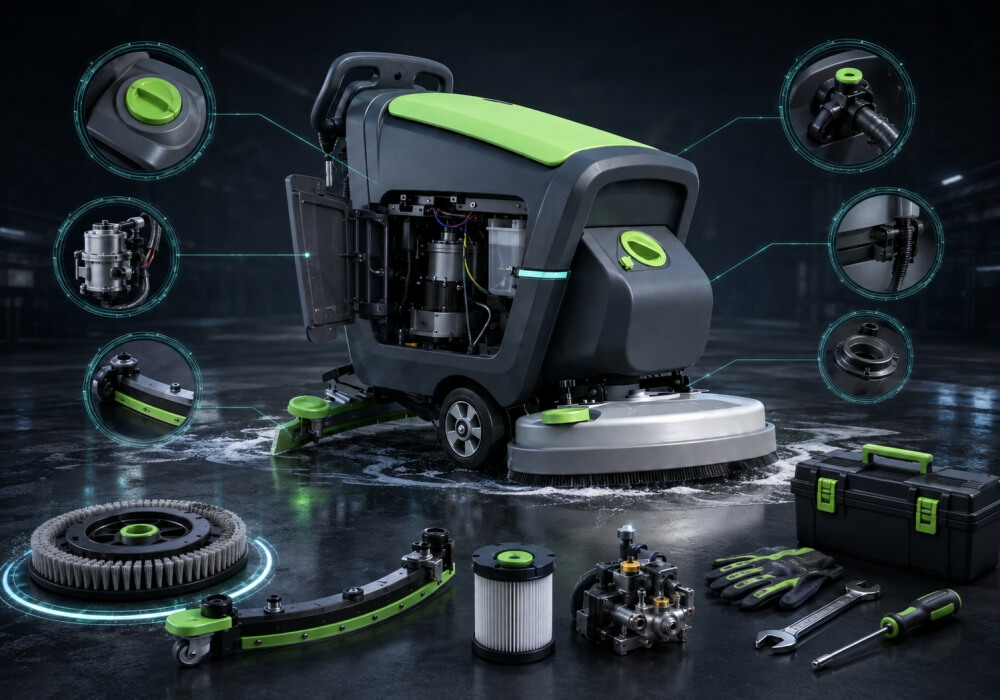
Maintenance planning affects long-term operating costs. Common maintenance tasks include brush inspection, filter cleaning, battery checks, and hopper servicing. For example, replacing worn brushes before performance drops can maintain cleaning quality and prevent unnecessary machine strain. Many commercial facilities review maintenance schedules every 3–6 months based on operating hours.
The choice between these two machines can also depend on floor layout.
| Facility Type | More Suitable Model | Reason |
|---|---|---|
| Small warehouse | 1250 | Easier movement around storage areas |
| Shopping center | 1250 | Better flexibility in mixed-use spaces |
| Large factory | LT-S1350S | Higher output for open floors |
| Distribution center | LT-S1350S | Longer operation and larger debris capacity |
| Parking facility | LT-S1350S | Suitable for wide outdoor surfaces |
A machine used in the wrong environment may not deliver expected efficiency. For example, placing a large industrial sweeper in a crowded facility may reduce its advantage because operators spend more time turning and avoiding obstacles. Similarly, using a compact sweeper in a large warehouse may require more cleaning cycles each day.
Cost evaluation should include labor time, maintenance frequency, and expected service life. A machine that reduces daily cleaning time by 30% can create measurable operational savings over several years. However, purchasing a larger model without sufficient floor space may increase unnecessary operating expenses.
The ride-on sweeper models available today cover a wide range of applications, from compact commercial machines to heavy-duty industrial equipment. Selecting between the 1250 and LT-S1350S requires matching machine specifications with actual cleaning conditions, including area size, debris type, working hours, and facility design.
The 1250 provides a practical option for medium-scale cleaning where flexibility matters. The LT-S1350S is more suitable for facilities requiring higher productivity and longer operation cycles. Both models can provide reliable floor maintenance when their features match the working environment, and the final selection should be based on daily cleaning requirements rather than general machine capacity alone.